
I take on the whole business change, and build every AI system it needs.
Not a tool you switch on. The whole operating machine, rebuilt around your business and installed on the systems you already own.
At the moment your best people spend most of their week keeping the business going. I take that work off them, put it onto systems that look after themselves, and hand the week back to growing the company.
That is the whole point of it. Not clever software, a week that goes where it should.
I work out the right answer for your business, rather than fit you to a template.
Twenty years operating businesses is what you're buying. It's what lets me see what a business actually needs, what to put in, in what order, and what each piece is worth. That judgement is the work.
What gets built is different for every company. The method, the promise and the way it's priced don't change.
Which of these your business needs, I won't know until I'm in it. That's the point. The answer is yours, not off a shelf.
You'll recognise your own desks in these.
Three of them, operating across the businesses I own. Each one used to take a person most of their week. Now it looks after itself, and that person is on the work that grows the company.
Manages the entire import and fulfilment operation, factory to shelf, nine markets, the paperwork and the cash, on a few minutes of sign-off a day.
Read the case studyEvery listing watched weekly, wasted ad spend hunted down, the Buy Box defended, and the money decisions brought back to me.
Read the case studyEvery set of books in one view, sourced numbers only, every decision logged, and every deadline on one radar.
Read the case studyThose are my own people, on my own desks. And the layer they all sit on:
Catalogue, orders, stock, logistics and the numbers, all in one view, with an agent sitting on every screen. It's the same idea behind an install like this: not a database you go and check, but a place the business operates from, that answers back.
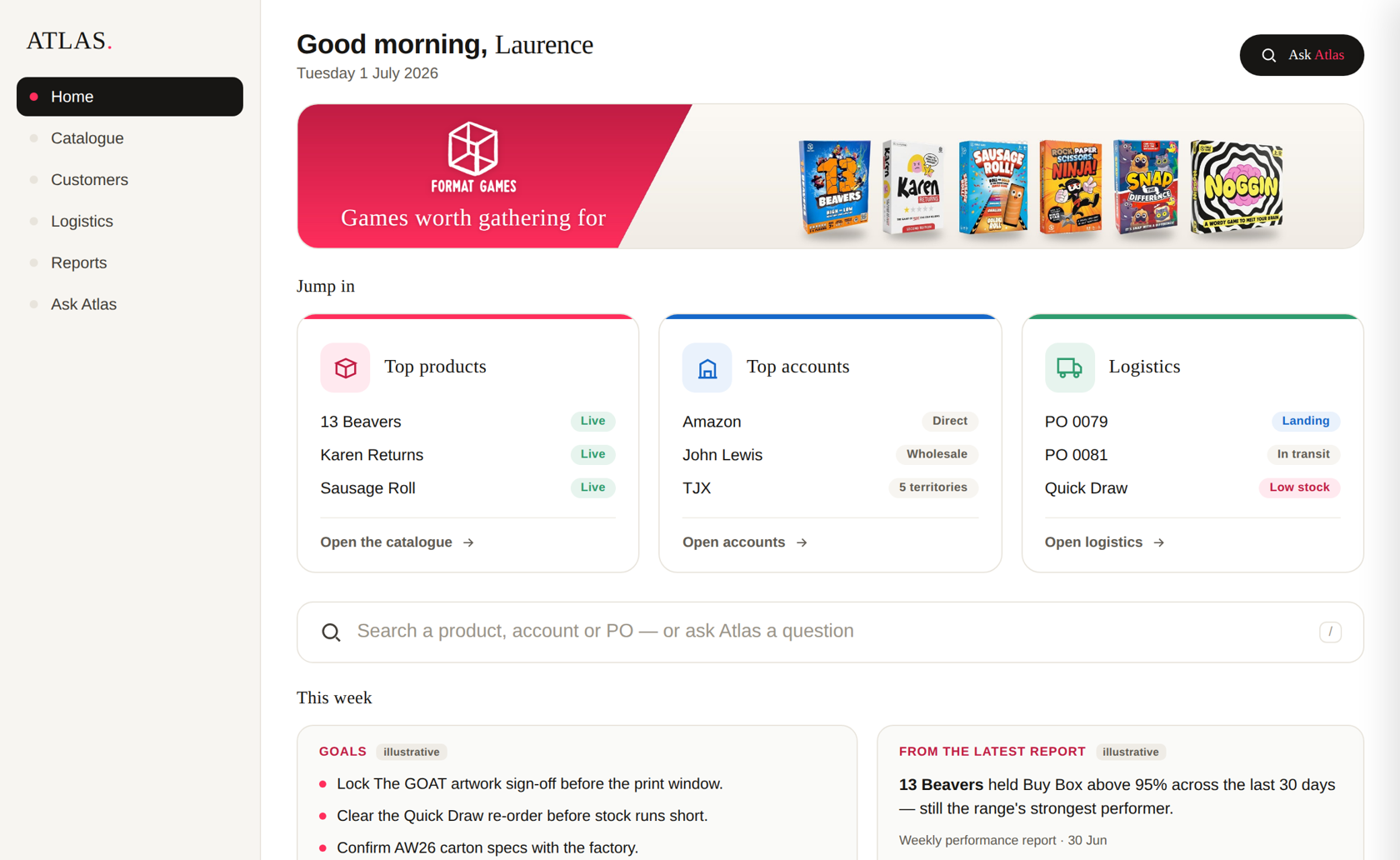
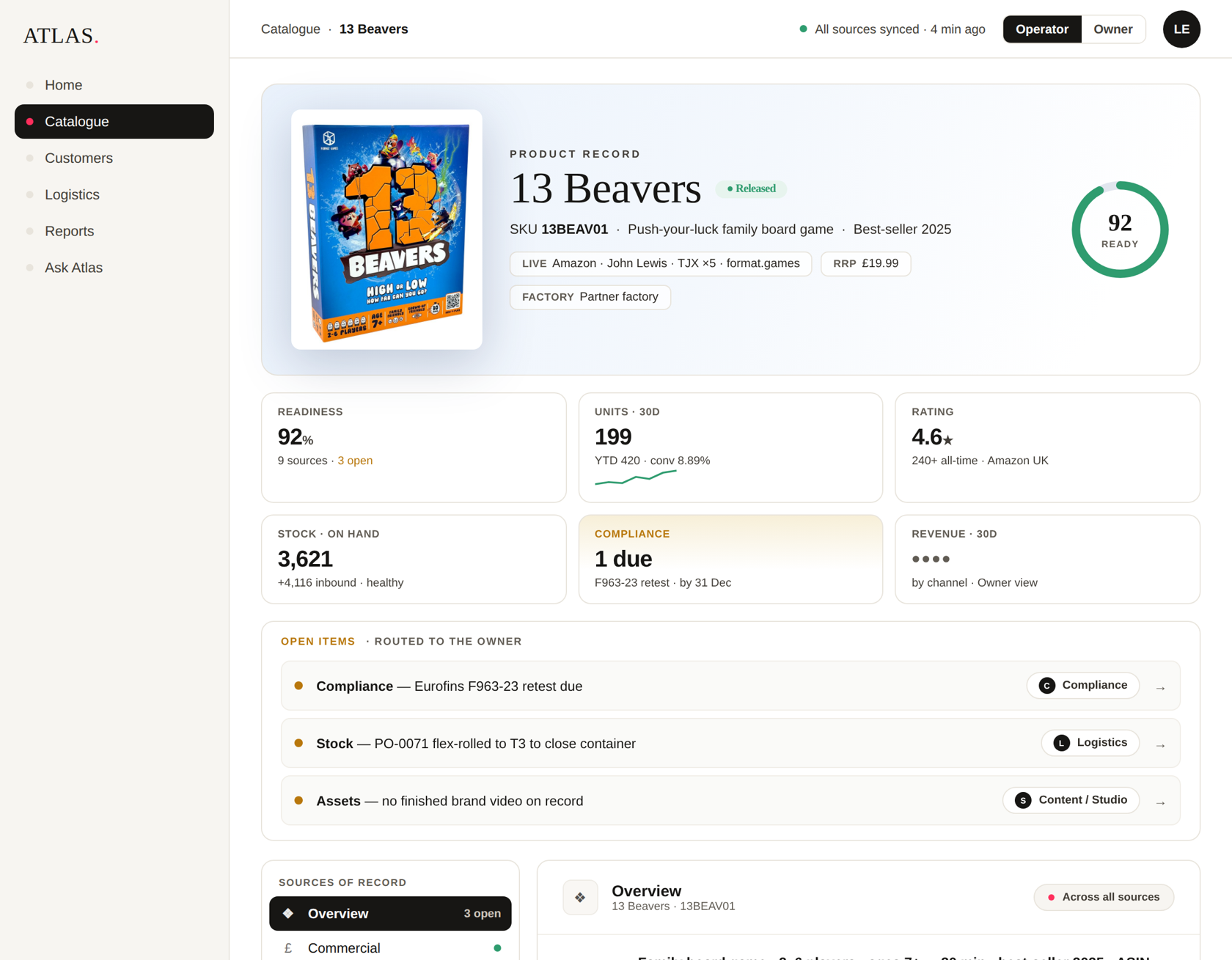
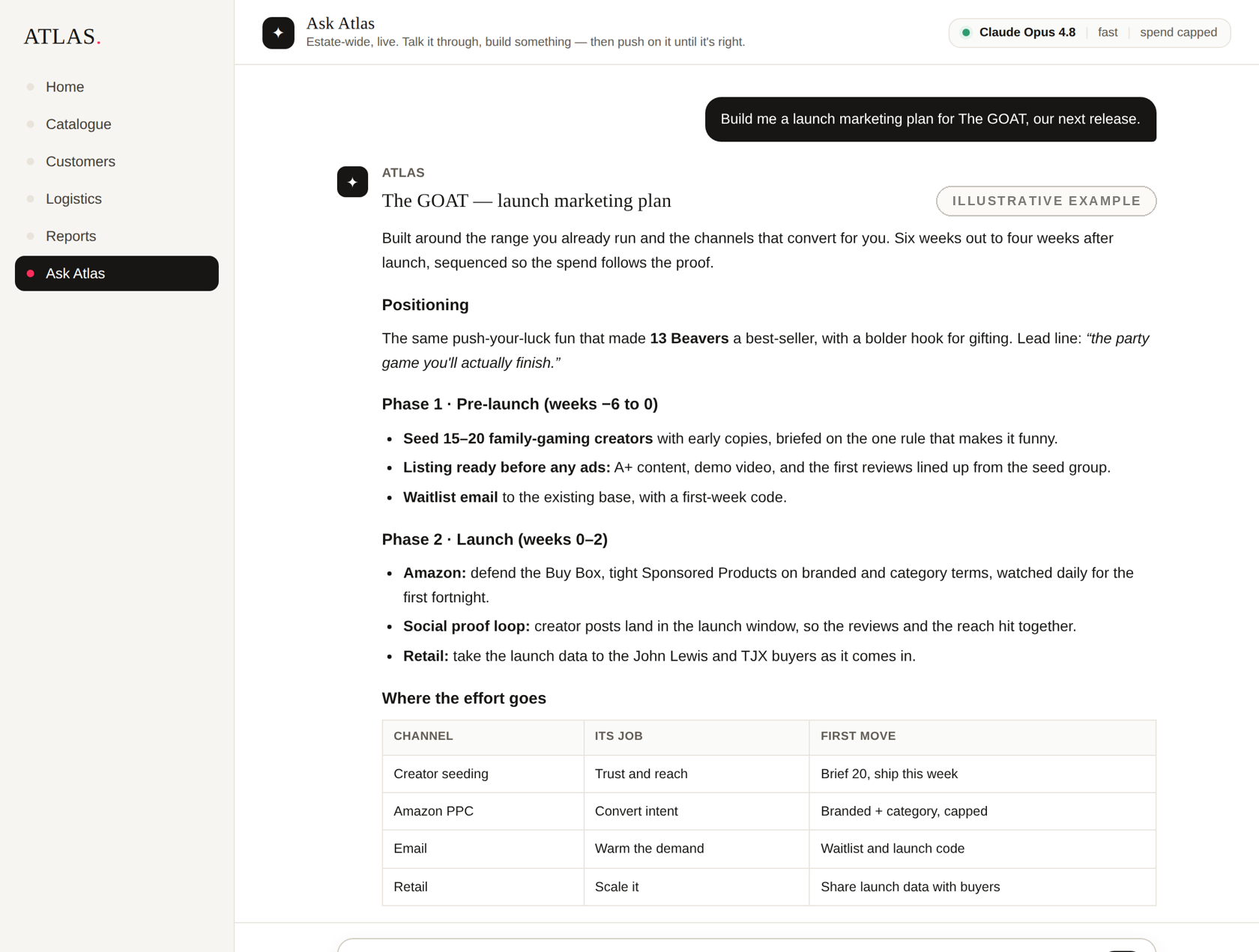
The list I install against, every line costed two ways.
It comes out of your Diagnostic: sequenced quick wins first, each line set against the work it takes off your desks, and each one has to pass a gate before the next begins. Here's the whole thing, for a worked example.
Illustrative example · Calder & Frome, a fictional 35-person food producer| What gets installed | Proof it's in | Days |
|---|---|---|
| 0Design & sign-offScreens mapped with the people who'll use them, kills adoption risk itself | Signed screen-map; five record owners named | 2–3 |
| 1Product & spec masterSpecs and price lists derive themselves, kills spec rebuilds and parallel price lists | One retailer spec accepted; first legacy folder retired | 3–4 |
| 2Customer record + order engineOrders land keyed, credit reasons captured, kills chasing and rekeying | A week's orders, no rekeying; reasons on 100% of claims | 4–5 |
| 3Stock & batch + promise-onceWired to orders and the plan, kills the Friday match and double keying | Matches a physical count; Friday match retired on a date | 3–4 |
| Individual Cowork agentsKey desks, quick wins included, kills the manual glue per desk | Each agent live on one real task | 1–2 |
| On-site testing & acceptanceYour team, your data, proves every line above | Every gate passed with its named signer | 2–3 |
| Training, go-live & supportOn-site, as each wave lands | Each team trained as its wave lands | 2–3 |
| SOPs, documentation & KPIsThe quick-wins programme, kills knowledge-stuck-in-people | Runbooks handed over; KPIs live with owners | 1–2 |
| The whole programme | Every wave ends in a gate you control | 18–26 |
Every line is costed two ways in your Diagnostic: your team puts it in, or I do. The figure is yours, taken from that list. And a wave that fails its gate doesn't proceed, or drag the next one down with it.
Installed one piece at a time, and each proves itself before the next.
We agree the look and the shape before anything goes in, so nothing lands as a surprise.
Records and reporting that come off the systems you already own. Usually the job is making what you have work harder, not replacing it.
Recruited, trained and given a job the same way I operate my own, each with a folder that acts as its brain.
On real work, with the people who'll actually use it. Not a handover deck.
Working sessions, documentation your team will use, a set of numbers on the wall that mean something, and the early wins driven through rather than left on a list.
Then the re-shape.
Your team re-forms around the room this frees, new roles where they're needed, and a plan for the effort that used to go into operating the machine. The saving is only real the day it's redirected, so I stay for that part too.
One figure that doesn't move.
I won't print a number here, because I'd be guessing and you'd be right not to trust it. The Rework is priced from your Diagnostic's install list, a list you've already seen, line by line, costed two ways.
It's months, not weeks, and the finish line is agreed with the price before anything starts. When it's done you won't need me at that intensity, that's the design. If you want a hand on the wheel afterwards there's a light way to do it, a session or two a month. Yours to choose, never a subscription you're locked into.